EV Performance architecture design (300 Km/h (186mph), 2,5s , 950 hp, 850 km)

- Détails
- Catégorie : Uncategorised
- Publication : mardi 9 juin 2026 07:46
- Écrit par Bensky
- Affichages : 499
EV Performance architecture design (300 Km/h (186mph), 2,5s , 950 hp, 850 km)
🚗⚡ What if we designed today a high-performance electric vehicle capable of competing with the world's leading EVs by 2030?
The concept presented here is an engineering exercise that illustrates how current and emerging technologies could be combined into a next-generation performance EV.
The targets are ambitious:
✅ Top Speed: 300 km/h (186 mph)
✅ 0–100 km/h: 2.5 seconds
✅ Peak Power: 700 kW (~950 hp)
✅ Peak Torque: 1,400 Nm
✅ WLTP Range: 850 km
✅ 10–80% Charging Time: 12 minutes
✅ 800 V Electrical Architecture
Achieving this level of performance is not simply about increasing motor power. True performance comes from a well-balanced system architecture where every subsystem is optimized to work together.
The vehicle is built around:
🔋 A next-generation 800 V battery pack delivering high energy density, long driving range, and ultra-fast charging capability.
⚡ A Silicon Carbide (SiC) power electronics platform that maximizes efficiency while reducing switching losses and thermal constraints.
🏎️ A high-speed PMSM electric powertrain capable of exceeding 22,000 rpm while maintaining excellent efficiency and power density.
🧠 A Software Defined Vehicle (SDV) architecture based on a centralized High-Performance Computer (HPC) and zonal controllers, enabling scalable vehicle functions and future software evolution.
🤖 Embedded Artificial Intelligence supporting energy management, predictive thermal control, vehicle dynamics optimization, and performance enhancement.
🛡️ A design developed from the beginning with functional safety, cybersecurity, redundancy, and over-the-air (OTA) update capabilities in mind.
Beyond the performance figures, this concept highlights the convergence of several key technology domains:
• Power Electronics
• Electric Powertrain Systems
• Embedded Software
• Artificial Intelligence
• Centralized & Zonal E/E Architectures
• Advanced Energy Management
• Software Defined Vehicles
The next generation of electric vehicles will not only be faster and more efficient.
They will also be smarter, continuously upgradable, and capable of improving throughout their lifecycle through software, AI, and connected services.
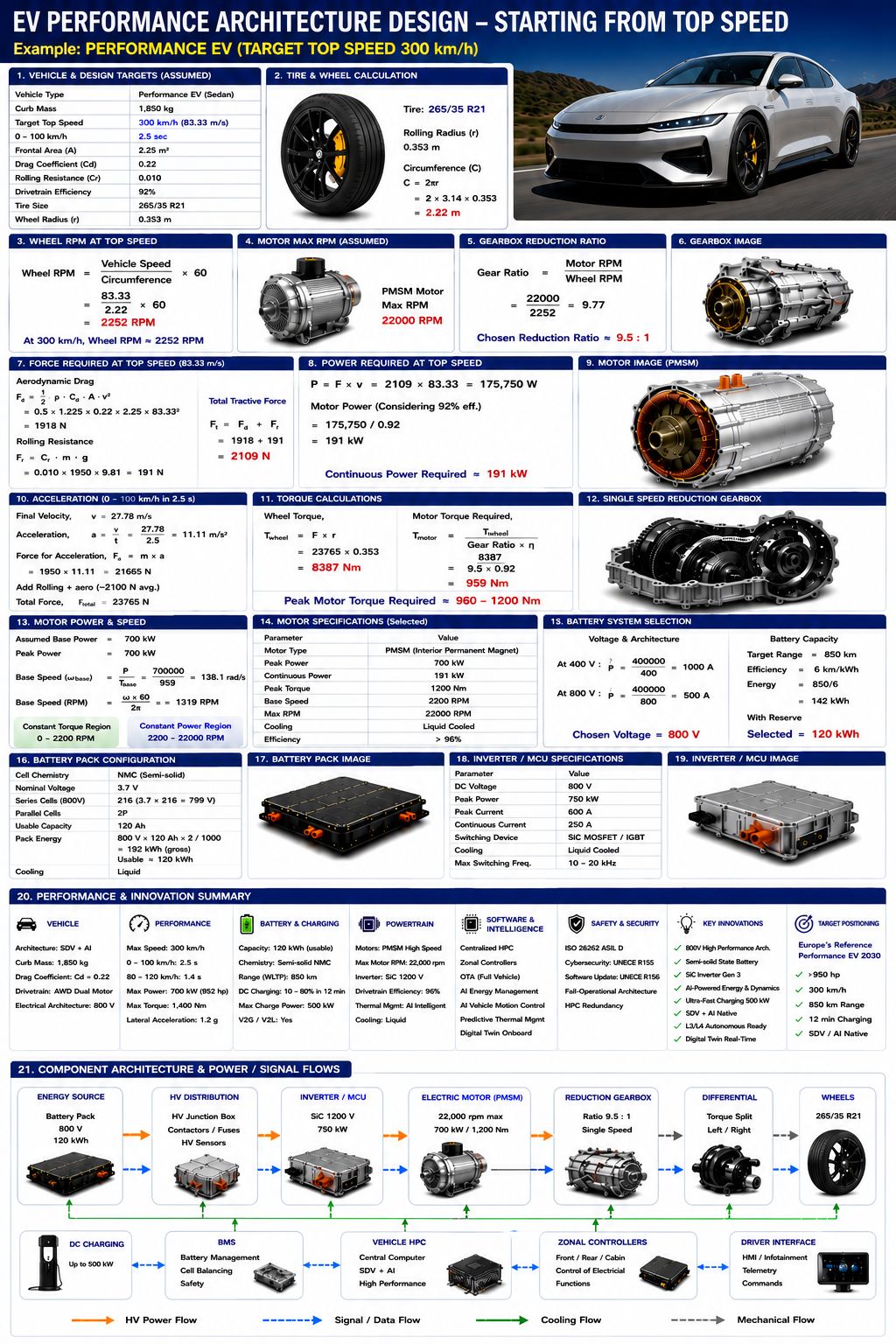
The technical infographic below presents a complete architecture proposal, including key vehicle assumptions, performance calculations, drivetrain sizing, battery selection, and system-level component interactions.
The future of mobility will be defined by the integration of hardware excellence, software intelligence, and energy efficiency.
hashtag#Automotive hashtag#ElectricVehicle hashtag#EV hashtag#PerformanceEV hashtag#Powertrain hashtag#BatteryTechnology hashtag#SoftwareDefinedVehicle hashtag#SDV hashtag#ArtificialIntelligence hashtag#VehicleArchitecture hashtag#PowerElectronics hashtag#FutureMobility hashtag#Innovation